Now & the Future written by Michael A Gomez May 20, 2026

It's no mistake that on this day, here where I live, it's May 20th. And in India, I believe that it is actually the 21st there. I think so. I'm still on the 20th right now, and I'm looking forward to my viewing of the ceremony. There's been a shift into everything that I was telling you days prior with the Long Life Ceremony and the recognition of the Buddha's birthday and enlightenment and his passing.
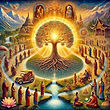
So the Buddha pointed to the path. He actually was the first one who paved that road to bring an end to suffering for us to follow, to bring an end to suffering in our lives individually. And so I bow to the path that he made for me, and that is the path that I walk upon. That is the path that liberates, and that is the path that transforms.
I move on in that path, keeping the beginner's mind throughout the whole process. And when I wander from that, I return to my breath. And I also have learned how to raise questions in moments where I need to disrupt some old pattern or habit that has existed for either years or decades, and working towards the point of those habits and patterns being completely broken and being set free from them, and the suffering that is connected to those habits and patterns.
Informing new habits and patterns that are good, that are healthy, that are wholesome, that won't bring suffering, where there is no attachment, where there is no craving or desire that brings in that same corruption that the old habits and patterns brought about. So this is a diligent walk on this path. It's not a path to be taken lightly, but at the same time it is one to be walked with joy.
And there's no promise that there will not be hardship or that there will not be trouble or difficulty. There will be. This is life. It will occur. But we compound that suffering by the choices we make, by old patterns and habits of the past. But this path has been shown to us. We've been pointed to this path by the Buddha himself and others as well, whose lives of devotion have pointed to the same path of liberation and transformation, cessation from suffering.
And this is the path that we who share this walk, this path laid by the Buddha himself — the first to travel this path, the first to discover the Four Noble Truths, the Eightfold Path, the Triple Gem. And I pay homage to the Buddha, the Dharma, and the Sangha. I bow to the path — the path of liberation, the path of transformation, the path that puts an end to suffering.
And I return to my breathing, and to the questions that will interrupt and disrupt old patterns that are destructive, old habits that are destructive. And this is the path of freedom. This is where those who have taken that path that was laid out before them, when challenges come, when difficulties come, when trouble comes — and they will — that by our choices we don't compound the suffering that's already in the world by adding more by our choices, by the things that we say, by the things that we do, and causing more hurt and pain and suffering for others, including ourselves.
We must first be compassionate to ourselves. This is where it begins. And that compassion will reach out to those around us. Now, we can't all claim to be ourselves a type of bodhisattva in the sense that the Dalai Lama or others who are of kind of a higher ranking — if you will, I don't know the right word — but we can all live in the path of what the bodhisattva is, and look to be a vessel to come and meet and suffer with those who are suffering, to actually be an embodiment and take on the suffering of others until the day comes where there is no more suffering, not one last individual left or sentient being left in suffering, and all have entered into Nirvana.
This is what the bodhisattva is for. This is what the aim is — that suffering would be brought to its end. And the life of the Dalai Lama, whom I bow to — the path — I bow to what is embodied within the seat of the Dalai Lama: the seat of compassion, and the compassion of the bodhisattva, the compassion of Avalokiteśvara, the compassion of Tara, and all of these that these represent in their embodiment within all the realm of Buddhist thought and Buddhist belief.
And whether or not you are a Buddhist, compassion is essential. Compassion is the very thing that can change the world for the better. There is much suffering in the world. Let's meet it with compassion. Let's enter in and suffer with those who are suffering. Let's be an embodiment of it so that others can see the way and see the path, and bow to that same path into a future where all have been set free and liberated and transformed — where there is joy, genuine joy, and happiness and peace within, and not just within but between everyone and all sentient beings.
Sp☸️ken Fr☮️m the Pa✝️h
Undergr☸️und_Guru
C☮️mmunications 2026


Comments